
Introduction
You're running ads. Your SEO rankings are climbing. Traffic is up. But the phone still isn't ringing enough, and the contact form sits mostly empty.
This is one of the most common frustrations business owners run into: paying for clicks that never turn into customers. Most websites convert only 2–3% of visitors, so the other 97% leave without calling, clicking, or buying. Conversion optimization (CRO) closes that gap by turning more of the traffic you already have into leads and sales.
This article breaks down what conversion optimization actually means, why it matters more than most businesses realize, the elements that separate a high-converting page from one that leaks leads, and a step-by-step framework you can start using this week.
Key Takeaways
- Conversion optimization increases the percentage of visitors who take action, without raising ad spend
- Data and testing drive results—not guesswork or one-time redesigns
- Small conversion rate gains compound into significant revenue over time
- A modest lift from 1% to 2% can double leads from the same traffic
- Businesses without in-house testing resources can lean on a marketing partner to run testing and optimization
What Is Conversion Optimization?
Conversion optimization is the systematic process of increasing the share of website visitors who complete a specific action you want them to take. There's no mystery or magic formula. It's structured improvement.
What counts as a "conversion" depends entirely on the business:
- Home services (HVAC, roofing, remodeling): a completed lead form or a tracked phone call
- Car dealerships: a contact request, trade-in appraisal, or scheduled test drive
- Nonprofits: a completed donation or a volunteer sign-up
- Medical practices: a booked appointment request
The Conversion Rate Formula
The math behind it is simple:
Conversion Rate = (Conversions ÷ Total Visitors) x 100
Say a roofing company's website gets 2,000 visitors in a month and generates 40 completed lead forms. That's 40 ÷ 2,000 x 100 = 2% conversion rate. Improve that to 3%, and you've added 20 leads without spending another dollar on traffic.
CTR vs. CVR: Why Both Matter
These two metrics get confused constantly, but they measure different stages of the same funnel:
| Metric | What It Measures | Formula |
|---|---|---|
| CTR (click-through rate) | How many people click an ad or link after seeing it | Clicks ÷ impressions x 100 |
| CVR (conversion rate) | How many of those visitors then complete the desired action | Conversions ÷ visitors x 100 |
A high CTR with a low CVR usually means your ads are working, but your landing page isn't. Both numbers have to work together, or the funnel leaks somewhere.
That post-click gap is what conversion optimization targets. Unlike SEO or PPC, which focus on how people find you, CRO focuses on what happens after someone arrives.
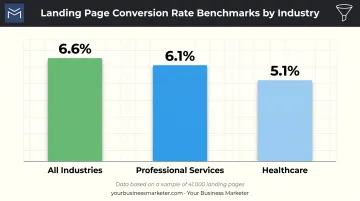
Unbounce's 2024 benchmark report, based on 41,000 landing pages and 464 million visitors, found a median landing page conversion rate of 6.6% across industries, with professional services at 6.1% and healthcare at 5.1%. Treat these as reference points, not universal targets.
Why Conversion Optimization Matters for Your Business
Improving your conversion rate is one of the fastest ways to grow revenue without touching your marketing budget. You keep the same ad spend and capture more value from the traffic you already have.
Here's the arithmetic, using fixed traffic:
| Monthly Visits | Conversion Rate | Leads Generated |
|---|---|---|
| 10,000 | 1% | 100 |
| 10,000 | 2% | 200 |
That single percentage point doubles the leads. Same traffic, same ad spend, twice the output.
This isn't theoretical. In a documented CXL case study, a lead-generation landing page for TruckersReport moved its email opt-in rate from 12.1% to 21.7% (a 79.3% relative lift) through six rounds of structured testing. No new traffic. Just smarter pages.
Most business owners know their conversion rate could be better. Few actually build a structured process to improve it. That's the gap between businesses that guess at redesigns and those that run ongoing tests.
This is also why traffic generation and conversion work shouldn't live in separate silos. Your Business Marketer builds conversion tracking into its industry programs (HIVE for home services, CLEAR for dealerships, FIT for nonprofits) so campaigns are measured against actual calls, leads, and customers—not just impressions or traffic snapshots.
SEO and PPC bring people to the door. Conversion strategy makes sure more of them walk through it.
Key Elements of a High-Converting Website
Clarity and a Single Clear Ask
Visitors decide within seconds whether a page is worth their attention. Your value proposition needs to answer one question immediately: what am I getting, and why does it matter to me?
Landing pages perform best when they stick to fundamentals:
- A headline that states the offer plainly
- One clear call-to-action, not three competing buttons
- Minimal navigation or distractions that pull attention away from converting
Trust Signals and Friction Reduction
People hesitate before handing over contact information or payment details. Reduce that hesitation with:
- Testimonials and reviews from real customers
- Guarantees or warranties, where applicable
- Security badges near forms or checkout
- Short forms — every extra field is a chance for someone to abandon
Speed and Mobile Experience
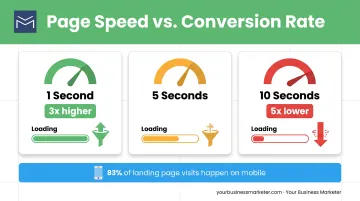
Page speed is a conversion factor, not a side technical concern. Portent's site speed research, based on over 100 million pageviews, found that a site loading in 1 second converted 3 times better than one loading in 5 seconds, and 5 times better than one loading in 10 seconds.
Mobile matters just as much. Unbounce has reported that 83% of landing page visits happen on mobile, yet desktop pages still converted about 8% better overall. If most of your traffic is mobile and your mobile experience is clunky, that gap is worth investigating first.
Personalization
Tailor messaging to referral source, past behavior, or buying stage. A first-time visitor from a Google ad should see different copy than someone returning from an email. Relevant offers convert better than one-size-fits-all pages.
How to Optimize Conversions: A Step-by-Step Framework
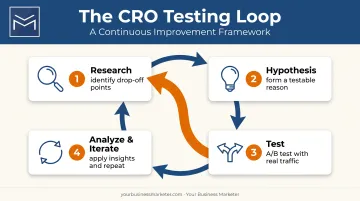
Optimizing conversions isn't a one-time redesign. It's a repeatable loop: research, hypothesize, test, analyze, repeat.
Research — Gather qualitative and quantitative data. Analytics on page views, form submissions, and bounce rate show where visitors drop off. One funnel logged 153 form starts, 5 completed leads, and a 2.98% conversion rate; call tracking compares total calls to unique callers over time.
Build a hypothesis — Every test needs a reason behind it. Not "let's try a red button" but "shortening the form from 8 fields to 4 will reduce abandonment because visitors hesitate at longer forms."
Test the change — A/B testing splits traffic between two page versions to see which performs better. You need enough visitors to reach statistical significance, typically a 95% confidence threshold. One insurance agency used dedicated landing pages, retargeting, and A/B testing to generate 48 leads within 90 days.
Analyze and iterate — Every test result, win or lose, informs the next hypothesis. A "failed" test still tells you something about what your audience does and doesn't respond to.
Common Conversion Optimization Mistakes to Avoid
CRO goes wrong in predictable ways. Watch for these:
- Testing too many changes at once. If you change the headline, the CTA, and the layout simultaneously, you won't know which change moved the needle.
- Ending tests early. Stop as soon as you see a promising result, before you reach statistical significance, and you often get false wins that fall apart later.
- Copying "best practices" blindly. What worked for another company's audience might do nothing for yours. Test it on your own traffic before trusting it.
- Not enough traffic or tools. Many small businesses simply don't have the visitor volume or internal bandwidth for a structured testing program.
This last point is where a lot of businesses stall out. Running proper tests takes traffic volume, tracking infrastructure, and time: three things most small business owners don't have to spare.
Your Business Marketer manages CRO alongside broader lead generation work, so conversion improvements happen in step with SEO and PPC campaigns instead of as a separate project.
Frequently Asked Questions
What does conversion optimization mean?
Conversion optimization is the process of increasing the percentage of website visitors who complete a desired action — a form, call, or booking — without needing more traffic. It focuses on getting more value from visitors you already have.
How do you optimize conversions?
Follow a repeatable cycle: research where visitors drop off, build a hypothesis for why, test the change with real traffic, then analyze results and repeat. It's ongoing, not a one-time fix.
What is CTR and CVR?
CTR (click-through rate) measures how many people click an ad or link after seeing it. CVR (conversion rate) measures how many of those visitors then complete your desired action. Both need to work together across the funnel.
What is a good conversion rate?
There's no universal number — it varies by industry, traffic source, and conversion type. Landing page benchmarks hover around 6.6% across industries, but the better goal is consistent improvement over your own historical rate.
What tools are used for conversion optimization?
Common categories include A/B testing platforms, web analytics tools, and heatmap or session recording software. Call tracking and form-analytics dashboards are also standard for lead-generation businesses.
Is conversion rate optimization the same as SEO?
No. SEO drives traffic to your site; CRO focuses on converting the traffic that's already arriving. They work best as complementary strategies rather than substitutes for each other.