Digital marketing isn't optional anymore — it's how customers find you in the first place. A 2025 Verizon survey of 600 U.S. small businesses found that 76% say social media positively affects their business performance. Yet limited time, tight budgets, and no in-house expertise leave many owners unsure where to even start.
Which channel actually drives revenue? How much should you spend? This guide covers building a marketing foundation, mastering core channels, budgeting with the 70-20-10 rule, tracking real ROI, avoiding common mistakes, and knowing when outside help is worth the investment.
Key Takeaways
- Nail down your audience and goals before you pick a single channel
- Run 2–3 channels well instead of a thin presence everywhere
- Use the 70-20-10 rule to fund proven tactics and small experiments
- Track KPIs so marketing spend maps to provable ROI
- Hire an agency when time or skill gaps cap what you can do in-house
Step 1: Build Your Marketing Foundation Before Choosing Channels
Jumping straight to "should I be on TikTok?" is how small businesses waste money. Get the foundation right first.
Define Your Target Audience & Ideal Customer
You don't need a 20-page persona document. You need three things: your top customer type, the problem they're trying to solve, and what they actually value when choosing a provider.
Example: A residential HVAC contractor might define their ideal customer as homeowners aged 35–65 in older homes. Their main problem is an aging or unreliable system, and they value fast response times and honest pricing over the cheapest quote.
Validate that assumption before building a strategy around it. Try:
- Short customer interviews (five conversations reveal more than you'd expect)
- A two-question survey sent to your existing customer list
- Google Business Profile and Facebook Insights data on who finds and engages with you
Set Clear, Measurable Marketing Goals
Vague goals like "get more brand awareness" don't tell you what to do next. Atlassian's SMART framework (Specific, Measurable, Achievable, Relevant, Time-Bound) fixes that by forcing a real number and a real deadline.
Instead of "increase visibility," try "generate 25 qualified leads per month from local search within 90 days." That's a goal you can actually build a plan around.
Your goals should also match your stage:
- Just getting started — goals around first consistent lead flow and proving which channels work
- Steady, established business — goals around retention, repeat business, and modest local growth
- Aggressive expansion — goals around new-market lead volume and faster customer acquisition
Budget Planning & The 70-20-10 Rule
There's no single "correct" marketing budget, but the Business Development Bank of Canada suggests a starting range: roughly 2-5% of revenue for B2B companies and 5-10% for B2C companies. Treat it as a planning range, not a rule. Your industry, margins, and growth goals still matter.
Once you have a budget number, the 70-20-10 rule helps you split it wisely:
- 70% on proven tactics — channels already generating results, like your local SEO and top-performing ad campaigns
- 20% on emerging tactics — channels showing early promise, such as a new social platform or a paid campaign format you haven't fully tested
- 10% on experimental ideas — higher-risk bets, like testing a new ad format or a content type you've never tried
A local landscaping company might split its budget like this:
- 70% into Google Ads and local SEO (proven)
- 20% into short-form video on Instagram (emerging)
- 10% into geofenced ads around competitor job sites (experimental)
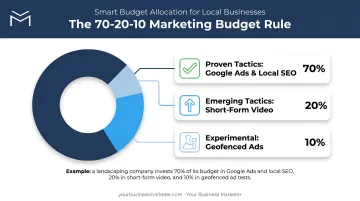
Revisit this split every few months. Campaign data will tell you when something in the "20%" bucket has earned a spot in the "70%" bucket.
Step 2: Master the Core Digital Marketing Channels
These channels aren't isolated tactics. They work as a connected system, each one supporting a different stage of the customer journey: from first discovering you to becoming a repeat customer.
Search Engine Optimization (SEO) & Local Search
Local search is where most small business revenue starts. BrightLocal's 2025 consumer survey found that 39% of consumers estimated at least 41% of their searches were devoted to finding local-business information. That's a large chunk of search intent pointed directly at businesses like yours.
Get the basics right:
- Complete your Google Business Profile — accurate hours, categories, photos, and service areas
- Target keywords with local intent — "AC repair Akron OH" beats generic terms like "HVAC services"
- Earn and respond to reviews consistently — Google names reviews as a factor in local ranking
The results can be substantial. Your Business Marketer worked with a family-owned Northeast Ohio HVAC contractor that had been in business since 1990 but was nearly invisible online. The program combined SEO, paid search, reputation management, and email marketing.
Within one month, website traffic jumped from 200 to nearly 1,000 monthly visitors, a 400% increase. The company also earned #1 Northeast Ohio rankings for terms like "AC Installation" and "Heating and Cooling." Over two years, that translated into an 85% increase in revenue.
Social Media Marketing
Don't try to maintain a presence on every platform. Pick one or two where your actual customers spend time, and go deep instead of wide.
Consistency and real engagement beat raw posting frequency. Focus on a few high-trust habits:
- Respond to comments and answer DMs quickly
- Use short-form video to show the people behind the business
- Stay steady on one or two platforms instead of going silent across five
Email Marketing
Email remains one of the highest-return channels available to small businesses. Litmus's 2025 State of Email research, based on nearly 500 marketing professionals, found strong returns across the board. About 35% of respondents earn $10-$36 for every $1 spent on email, and another 30% earn $36-$50.
Start simple:
- Capture emails through website sign-ups and at checkout
- Build a welcome sequence for new subscribers
- Send a retention or newsletter email to keep past customers engaged
Retention is easy to underinvest in. The HVAC case study above used its existing list of 1,800 customer emails to launch a monthly newsletter, staying top-of-mind for repeat work and referrals.

Content Marketing
Content is the engine behind SEO, social, and email, not a separate channel competing for its own budget. One well-written blog post or short video answering a real customer question (think: "how often should I replace my HVAC filter?") can be repurposed into a social post, an email, and an SEO landing page.
A simple monthly content calendar, even just four planned topics, keeps this consistent without overwhelming a small team.
Paid Advertising (PPC & Social Ads)
Start small. Pick one platform, set a modest daily budget, and test one variable at a time (a headline, an image, or a targeting audience) before scaling spend.
Paid search also sits next to a bigger shift in how people find answers. AI-generated summaries now appear directly in search results and can resolve a question before anyone clicks a website. Track visibility inside those answers (often called Generative Engine Optimization, or GEO) alongside your usual organic and paid rankings so you know where demand is moving.
Step 3: Turn Strategy into Execution
Strategy without execution is just a document nobody follows. Here's how to make it operational.
Build a Simple, Repeatable Marketing Plan
A lean marketing plan needs four things:
- Goals — the specific, measurable outcomes from Step 1
- Audience — who you're targeting and where they spend time online
- Channels — the 2-3 you've realistically matched to your time and budget
- Cadence — monthly planning sessions, weekly execution tasks
Resist the urge to add a fourth or fifth channel just because a competitor is doing it. Digital marketing involves real trial and error. Early weeks will feel more like testing than winning. Traction usually builds over a few months, not a few days.
Key Metrics (KPIs) to Track for ROI
Track these KPIs so you know what's actually driving results:
- Website traffic — overall and by source (organic, paid, social, email)
- Conversion rate — visitors who become leads or customers
- Cost per lead — total spend divided by leads generated
- Return on ad spend (ROAS) — revenue generated per dollar of ad spend
- Revenue attribution — which channel actually closed the sale
Free and low-cost tools cover most of this: Google Analytics for traffic and conversions, UTM tracking links for source-level detail, and built-in dashboards on ad platforms like Google Ads and Meta.
Review performance monthly or quarterly, and shift budget toward whatever the data proves is working.
Common Small Business Marketing Mistakes to Avoid
Even well-intentioned marketing efforts fail for predictable reasons:
- Spreading too thin: trying to maintain five channels at once instead of mastering two or three
- Skipping conversion tracking: running campaigns with no way to know which leads or sales they actually generated
- Expecting instant results: abandoning a campaign after three weeks when it needed three months
- Ignoring mobile optimization: a slow or clunky mobile site turns away customers before they even see your offer
Each of these mistakes is fixable. Most come down to impatience or a lack of measurement, not bad strategy.
DIY or Delegate? Deciding When to Partner with a Digital Marketing Agency
DIY marketing works when you have time, a clear channel focus, and room to learn. Delegation makes more sense once complexity outpaces capacity.
Some signs it's time to bring in outside help:
- You consistently run out of time before running out of marketing tasks
- You lack in-house expertise across SEO, paid ads, and social simultaneously
- Growth has plateaued despite steady effort
A full-service agency managing SEO, paid ads, social, and reputation under one roof solves a real coordination problem. You stop juggling three freelancers who don't talk to each other or duplicating work across disconnected platforms.
Your Business Marketer (YBM) is one example of this model. Founded in 2016 and based in Hudson, Ohio, YBM is a founder-led, full-service agency built around industry-specific programs rather than generic packages. Those include HIVE for home services and home improvement contractors and CLEAR for car dealerships.
Founder Mike Snellenberger previously worked as marketing director for a chain of car dealerships and managed his own companies before starting YBM. That background gives the agency a practical, owner's-eye view of what drives growth.
Documented results support the approach. Beyond an HVAC contractor's 85% revenue growth, YBM helped a newly opened used car dealership reach profitability within 75 days and generate over 3,300 online leads in six months, with an average 19X return on marketing spend.

For businesses without the bandwidth to run multi-channel marketing in-house, that measurable track record is what a specialized partner should deliver.
Frequently Asked Questions
What is the 70-20-10 rule in digital marketing?
It's a budget-planning rule: 70% of your marketing budget goes to proven tactics that reliably work, 20% to emerging tactics showing promise, and 10% to experimental ideas. It balances reliability with room to innovate.
How much should a small business budget for digital marketing each month?
A common benchmark is 2-5% of revenue for B2B businesses and 5-10% for B2C businesses, though your specific goals and industry matter too. Start smaller, and scale up as you see measurable performance.
Which digital marketing channel should I start with as a small business?
Start with the channel closest to a sale, usually local SEO and your Google Business Profile. It captures customers who are already searching for what you offer, before expanding into social, email, or paid ads.
How long does it take to see results from digital marketing?
Paid ads can generate leads within days of launching, while SEO and content marketing typically take weeks to a few months to show measurable movement. Give any new campaign at least 90 days before judging its performance.
Should I handle digital marketing in-house or hire an agency?
If you have the time and multi-channel expertise, in-house can work. If you're stretched thin or growth has stalled, a full-service agency under one roof often gets results faster than piecing together freelancers.
What's the difference between SEO and PPC advertising?
SEO is the ongoing work of improving your visibility in organic (unpaid) search results. It's free to appear, but takes time to build. PPC means paying for each click on an ad, which delivers visibility immediately but stops the moment you stop paying.