Most nonprofit leaders we talk to share the same frustrations: stretched staff wearing five hats, no clear sense of which channel actually drives donations, and a marketing plan that lives in a Google Doc nobody has time to execute.
This guide walks through building a real marketing plan, the channels worth your limited time, how to measure what's working, and when it makes sense to bring in outside help.
Key Takeaways
- Consistent marketing builds donor trust, and trust drives giving over time
- A written plan with SMART goals turns scattered effort into measurable results
- SEO, the Google Ad Grant, and email marketing offer the best return for tight budgets
- Tracking donor retention and cost-per-donation matters more than vanity metrics like likes
- Bring in outside support when DIY marketing costs more time than it saves
Why Nonprofit Marketing Matters
Marketing isn't a luxury line item for nonprofits. It's the mechanism that turns mission awareness into actual donations, volunteer sign-ups, and partnerships.
Trust Drives Every Donation Decision
Donors give to organizations they trust, and right now, that trust is in short supply. A late-2025 survey of more than 1,500 U.S. adults found that 67.7% consider trust essential before donating, yet only 18.3% reported high trust in charities overall, per Give.org's Donor Trust Report.
That gap is an opportunity. Consistent, transparent marketing — clear impact reporting, visible outcomes, real stories — is one of the few tools a nonprofit controls to close it.
Marketing also does the heavy lifting for fundraising. Campaign pages, event promotion, and donation asks only convert when the right people see them at the right time.
Beyond dollars, staying visible pays off in three other ways:
- Volunteer recruitment: Your mission shows up where people already spend time online
- Staff retention: Public recognition of impact helps people stay proud of the work
- Partnerships: Corporations and community groups gravitate to a strong, consistent presence
Building Your Nonprofit Marketing Plan
A marketing plan is a working document that defines who you're talking to, what you're saying, and how you'll know it's working.
Start With Mission and Messaging
Every plan begins with a clear mission, vision, and value proposition. Translate that into consistent language: the same tone, key phrases, and core promise across your website, social posts, emails, and print materials. Inconsistent messaging is one of the fastest ways to lose donor trust.
Build Supporter Personas
Segment your existing donors, volunteers, and beneficiaries by:
- Age and life stage
- Giving history and gift size
- Interests or cause affinity
- Preferred communication channel (email, text, mail, social)
These personas guide everything downstream, from which platform you post on to what your email subject lines sound like.
Set SMART Goals
Vague goals like "grow awareness" don't get executed. Specific ones do. Aim for targets such as increasing online donations by 20% within six months or growing event attendance by 15% year-over-year. Each goal should be Specific, Measurable, Achievable, Relevant, and Time-bound.
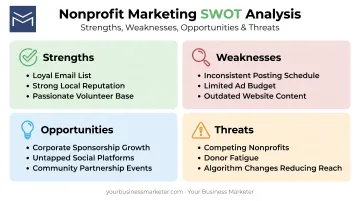
Run a SWOT Analysis
Look honestly at your current marketing:
- Strengths — What's already working (a loyal email list, strong local reputation)?
- Weaknesses — Where are the gaps (no SEO, inconsistent posting)?
- Opportunities — Untapped channels or partnerships (local media, corporate sponsors)?
- Threats — What could slow you down (competing nonprofits, funding cuts, shifting donor habits)?
Keep Branding Consistent
Your logo, color palette, fonts, and imagery should look identical whether someone finds you on Facebook, in a fundraising email, or on a flyer at a community event. Uniform branding builds recognition faster than any single campaign can.
Plan the Budget
Advertising spend among nonprofits is modest. Research on Form 990 filings from more than 7,000 U.S. nonprofits found a median advertising expense equal to roughly 0.12% of total spending across all organizations, rising to about 0.66% among those that report advertising costs at all.
There's no single correct percentage for total marketing spend. It depends on organization size and goals, but most nonprofits under-invest in visibility. Split your budget across four buckets and revisit the mix each quarter:
- Staffing time
- Technology and tools
- Paid media
- Content creation
Best Nonprofit Marketing Strategies and Channels
Not every channel deserves equal attention. Here's where the actual return lives.
Website and SEO
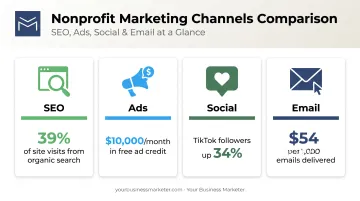
Your website is the foundation everything else points back to. Organic search delivered 39% of nonprofit website visits in 2025, according to M+R's Benchmarks report, which also found nonprofits convert about 1.6% of visitors into donors, generating roughly $1.33 per visitor.
That makes SEO (keyword research, quality content, mobile-friendly design) one of the highest-return investments a nonprofit can make.
The Google Ad Grant
Eligible 501(c)(3) organizations can receive up to $10,000 per month in free Google Search ad credit, according to Google's official Ad Grants program page. Nonprofits use it to promote donation pages, upcoming events, and educational content.
Eligibility requires IRS 501(c)(3) status and verification through Google's partner, Goodstack. Government entities, hospitals, and schools generally don't qualify.
Social Media and Video
Platform priorities differ by audience:
| Platform | Nonprofit average audience | Notable trend |
|---|---|---|
| ~53,000 | 3% year-over-year growth | |
| ~18,000 | Strong storytelling engagement | |
| TikTok | ~3,000 | Follower counts up 34% in 2025 |
Short-form video performs especially well. Candid produced over 100 TikTok, Reels, and Shorts videos in a single year and generated more than 250,000 views, with overall engagement across its channels more than doubling.
Staff-led, first-person videos consistently outperformed polished production.
Email Marketing
Segmentation and automation turn one-time donors into recurring ones. Tactics that beat generic blasts include:
- Nurture sequences for new donors
- Birthday or anniversary-of-giving messages
- Personalized asks tied to giving history
Fundraising emails currently see a 0.59% click-through rate and generate about $54 per 1,000 emails delivered, per M+R's 2026 data. Modest numbers, but they add up at scale.
Storytelling and Content
Impact videos, donor testimonials, and blog posts humanize your data. "We served 30,000 people" is a fact. "Here's how we helped Maria find stable housing" is a story people remember and share.
Don't Abandon Offline Channels
Direct mail, flyers, and local partnerships still matter. Research from NextAfter found donors who engage across both online and offline channels were worth nearly three times as much as single-channel donors. A multi-channel approach consistently outperforms betting everything on one platform.
Measuring and Optimizing Your Marketing Impact
Tracking the right numbers separates guesswork from strategy.
Core Marketing KPIs
Pull these from Google Analytics and native platform dashboards:
- Website traffic and conversion rate: how many visitors take a desired action
- Email open and click-through rates: whether messages get opened and acted on
- Social media engagement and follower growth: reach and resonance over time
Fundraising-Specific Metrics
Your CRM or donor management system should track:
- Donation conversion rate: share of visitors who actually give
- Recurring donor retention: M+R found monthly donors retain at 71% after one year, versus 48% for one-time online donors
- Monthly giving share: recurring gifts now supply 27% of online revenue for the average nonprofit
Set a Review Cadence
Monthly check-ins catch problems early. Quarterly reviews compare results against your SMART goals and show when to shift budget between channels.
Use those reviews to optimize, not just report: double down on channels that lower cost per donor and lift retention, and reallocate away from what stalls. Skip this step and the same weak tactics run for years.
When to Partner with a Nonprofit Marketing Agency
DIY marketing works until it doesn't. Common signs you've outgrown it:
- Social posting has gone quiet for weeks at a time
- No one has bandwidth to manage SEO or ad accounts
- A marketing plan exists on paper but was never actually executed
A dedicated nonprofit marketing partner typically handles SEO, paid search and social advertising, email marketing, and reputation management. That frees internal staff to focus on programs and donors instead of ad dashboards.
When those gaps show up, a specialized partner can cover the channels without adding headcount. Your Business Marketer's FIT for Nonprofit program includes programmatic advertising, paid and organic social media management, SEO, geofencing, and conversion-focused reporting. The focus stays on actual donations and conversions, not impressions alone.

The YBM Gives Back initiative shows what dedicated support can look like in practice. In 2022, YBM awarded a six-month, $15,000 marketing package to Coleman Health Services, an Ohio nonprofit that served more than 30,000 local clients.
The package included programmatic donor advertising, paid and organic social media, website optimization, and custom creative assets—the same structure smaller organizations often can't build on their own.
Frequently Asked Questions
What are the best marketing strategies for nonprofits?
The strongest combination is a well-optimized website with SEO, the Google Ad Grant, social media storytelling, and segmented email marketing. The right mix depends on your specific audience and goals.
What is a nonprofit marketing plan and why does my organization need one?
A nonprofit marketing plan is a roadmap covering your audience, channels, messaging, and goals. Without one, outreach becomes inconsistent and hard to measure over time.
What is the Google Ad Grant and how can nonprofits use it?
Eligible 501(c)(3) organizations can get up to $10,000 per month in free Google Search ad credit. Nonprofits commonly use it to promote donation pages, events, and educational content.
How much should a nonprofit spend on marketing?
Budgets vary by size and goals, so there's no universal rule. Most nonprofits spend well under 1% of total expenses on advertising alone — many have room to invest more.
What are the most effective marketing channels for nonprofits with limited budgets?
Email, organic social media, SEO, and the Google Ad Grant usually deliver the strongest return when paid media budgets are tight.
How can nonprofits measure the ROI of their marketing campaigns?
Track engagement, conversions, and donations against campaign cost in Google Analytics and your CRM or donor management system. Compare those results to your SMART goals each quarter and double down on what converts.