Picking the wrong one isn't a minor mistake — it can burn through your budget for months with nothing to show for it. US digital ad revenue hit $294.6 billion in 2025, with search advertising alone accounting for $114.2 billion, or 38.8% of that total, according to the IAB/PwC Internet Ad Revenue Report. Social media advertising isn't far behind, at $117.7 billion and growing faster year-over-year. Both channels are massive. Only one of them fits your business.
Key Takeaways
- Google Ads captures existing demand; Facebook Ads creates demand through interest and behavior targeting
- Facebook Ads usually costs less per click; Google Ads often converts better for high-intent industries like home services
- Neither platform wins universally: the right pick depends on sales cycle, budget, and campaign goal
- Combining both platforms in a full-funnel strategy is common among the highest-performing small business campaigns
- A partner like YBM matches platform strategy to real business objectives instead of guesswork
Google Ads vs Facebook Ads: Quick Comparison
Here’s the side-by-side breakdown most business owners need before choosing a platform.
| Factor | Google Ads | Facebook Ads |
|---|---|---|
| Cost Per Click | Higher on average — median $5.42 across industries, up to $9.87 for legal and $8.33 for home improvement (WordStream, 2026) | Lower on average — median $0.70 for traffic campaigns, $1.92 for leads campaigns (WordStream, 2025; no public link in source notes) |
| Buyer Intent | High — users are actively searching with purchase or research intent | Lower — users are scrolling passively, not actively shopping |
| Targeting Method | Keywords, search queries, demographics, in-market audiences | Interests, behaviors, demographics, Lookalike Audiences |
| Ad Formats | Text search ads, Shopping, Display, YouTube video | Image, video, carousel, Stories/Reels |
| Best For | High-intent, service-based, and B2B businesses | Visually-driven products, launches, impulse purchases |
Both platforms work. They’re built for different jobs.
What is Google Ads?
Google Ads is Google's pay-per-click platform. It places your text, Shopping, or video ads across Search, the Display Network, and YouTube. For a small business, that means showing up the exact moment someone types "HVAC repair near me" into their phone.
The appeal is straightforward. Google Ads delivers:
- Faster lead generation than organic SEO, which can take months to build momentum
- Precise budget control, with daily spend limits you set and adjust anytime
- Measurable ROI through conversion tracking tied to actual calls, form fills, and sales
How the Auction Actually Works
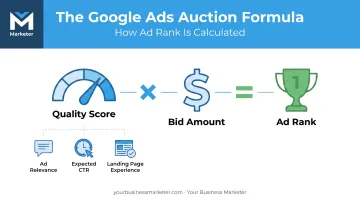
Google doesn't just hand the top spot to the highest bidder. Your Quality Score (a measure of ad relevance, expected click-through rate, and landing page experience) combines with your bid to determine Ad Rank. A smaller advertiser with a tightly relevant ad can outrank a bigger competitor throwing more money at broad keywords.
Common campaign types include:
- Search: text ads on the results page for high-intent queries
- Display: visual banner ads across millions of partner sites
- Shopping: product listings for e-commerce
- Performance Max: automated, cross-network campaigns
- YouTube: video ads for awareness and consideration
When Google Ads Works Best
Google Ads shines when someone already knows they have a problem and is actively looking for a solution. Think "near me" and service-specific searches happening at the exact moment of need.
Industries where it dominates:
- Home services: HVAC, plumbing, roofing, remodeling
- Medical and dental practices: patients searching for specific treatments
- Senior living and local care: families researching communities and services near them
- Car dealerships: shoppers researching specific makes and models
The numbers back this up. Home services Search campaigns convert at a median rate of 7.33%, with plumbing hitting 7.63% and HVAC repair at 6.56%, according to LocaliQ's 2025 benchmark report. That's a strong conversion floor for an industry where every lead can be worth thousands of dollars.
What is Facebook Ads?
Facebook Ads (technically Meta Ads now) spans Facebook, Instagram, Messenger, and the Audience Network. It matters most when you're trying to reach people who aren't searching for you yet, because they don't know they need you.
Core benefits include:
- Cost-efficient reach for building brand awareness at scale
- Visual storytelling that builds trust before someone's ready to buy
- Retargeting for website visitors who browsed but didn't convert
Auction Mechanics Differ From Google's
Meta's auction runs on a Total Value Score, combining your bid, estimated action rate, and ad quality. Unlike Google, where keyword relevance rules, Facebook rewards strong creative directly. A scroll-stopping video can lower your costs meaningfully compared to a flat, generic image ad.
Format subtypes include:
- Image ads
- Video ads
- Carousel ads
- Collection ads
- Stories and Reels
Use Cases of Facebook Ads
Facebook Ads fits earlier in the customer journey. It introduces your business to people who don't yet realize they need it, then stays visible through retargeting until they're ready to act.
Industries where it performs especially well:
- Home services contractors building local awareness before homeowners search
- Senior living communities reaching family decision-makers
- Automotive dealerships driving vehicle discovery and offer campaigns
- Home improvement brands inspiring projects before the quote request
Meta itself reports carousel link ads can produce 30-50% lower cost per conversion and 20-30% lower CPC compared to single-image ads. Format choice matters as much as targeting on this platform.
Google Ads vs Facebook Ads: What is Better?
Google Ads vs Facebook Ads: Which Is Better?
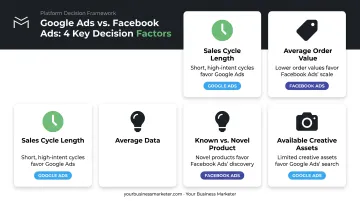
The honest answer: it depends on four things.
- Sales cycle length: short cycles favor Google's high-intent capture; long cycles benefit from Facebook's nurture-and-retarget approach
- Average order value: higher-ticket services often justify Google's higher CPCs
- Known vs. novel product: if people already search for it, go Google; if it needs explaining or showing, go Facebook
- Available creative assets: Facebook demands strong visuals; Google rewards relevant copy and landing pages
Pick the platform that matches how you sell:
- Google Ads: high-intent local searches and fast conversions (home services, medical practices)
- Facebook Ads: awareness for visually driven or brand-new products
- Both: when budget supports a full-funnel approach
Real-World Example: Google Ads Driving Local Service Growth
A Northeast Ohio HVAC contractor came to YBM with a familiar problem: inconsistent lead flow and heavy reliance on referrals, with nearly two-thirds of revenue tied to a single large client. One account driving most of the revenue left the business exposed.
YBM built out a targeted Google Ads search campaign focused on high-intent local service keywords, layered alongside SEO, reputation management, and social media as part of a broader strategy. The result over two years was 85% overall revenue growth, including $850,000 in additional revenue and a documented 12x return on investment.
The takeaway: home services businesses with clear, searchable demand see the fastest ROI from Google Ads when campaigns are properly managed and paired with the right supporting channels.
If you run a home services or home improvement business and want to see what a properly managed paid search strategy could do for your lead flow, YBM's HIVE program is built specifically for that.
Conclusion
Neither platform wins outright. Google Ads captures demand that already exists: people typing in exactly what they need, right when they need it. Facebook Ads creates demand where none existed yet, using visuals and targeting to introduce your business before the search even happens.
The right call comes down to your sales cycle, your budget, and what you're actually trying to accomplish this quarter.
You don't have to pick a side permanently, either. Many strong local businesses run both platforms at once, using Facebook to build awareness and Google to close the loop. If that mix still feels like guesswork, YBM can manage Google Ads and paid social for you so you can focus on running the business.
Frequently Asked Questions
Is $10 a day enough for Google Ads?
It can work for testing in low-competition niches, but it's often too thin for competitive local service industries. Google's own guidance suggests enough budget to reach roughly 30 conversions a month for meaningful optimization.
How much do Facebook Ads cost per 1,000 views?
Recent benchmarks put average CPM around $5.61 to $8.96, though costs swing based on industry, audience size, and creative quality. Awareness campaigns tend to run cheaper than lead-generation campaigns.
Do Google Ads work better than Facebook Ads?
"Better" depends entirely on intent. Google typically wins on high-intent conversions, while Facebook typically wins on cost-efficient awareness and discovery.
Which platform is better for beginners?
Facebook Ads tends to be friendlier for beginners, with lower minimum budgets and a simpler setup. Google Ads has a steeper learning curve around keywords and bidding strategy.
Can I use Google Ads and Facebook Ads together?
Yes. Facebook builds awareness while Google captures the resulting search demand and closes the sale. YBM implements this full-funnel combination regularly for clients across industries.
What is a good conversion rate for Google Ads vs Facebook Ads?
Google Search campaigns average around 8.18% across industries, while Facebook lead campaigns average closer to 7.72%. "Good" ultimately depends on your industry and customer lifetime value.