Unlike a retail brand pushing product photos, nonprofits carry a tougher balancing act. They need to share real stories, stay transparent about how funds get used, and still ask supporters to give, without burning out their audience. Outcomes vary widely depending on strategy, consistency, and how much staff time an organization actually has to spare.
This guide covers the full process: setting goals, picking the right 2-3 platforms, applying proven content frameworks like the 70/20/10 and 5-5-5 rules, avoiding common missteps, and knowing when outside help makes sense.
Key Takeaways
- Set platform-specific goals for fundraising, awareness, or volunteer recruitment before creating content
- Focus on 2-3 core platforms where your donors and volunteers already spend time
- Apply the 70/20/10 content ratio to balance storytelling, curation, and fundraising asks
- Review real engagement and conversion data monthly, not just follower counts
How to Build a Nonprofit Social Media Strategy: A Step-by-Step Guide
Building a strategy that actually holds up under a lean team means working through these steps in order, not jumping straight to posting.
Step 1: Define Your Goals and KPIs
Every social goal should connect to a bigger organizational priority, whether that's fundraising, volunteer recruitment, general awareness, or even staff hiring. Vague goals like "grow our following" don't hold anyone accountable. Use the SMART framework instead: specific, measurable, achievable, relevant, and time-bound.
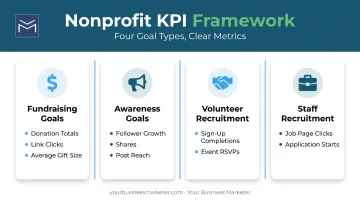
Match your KPIs to the goal type:
- Fundraising goals → donation totals, link clicks, average gift size
- Awareness goals → follower growth, shares, post reach
- Volunteer recruitment → sign-up form completions, event RSVPs
- Staff recruitment → job page clicks, application starts
Skipping this step is the fastest way to end up with a feed full of pretty posts and no way to prove they're working.
Step 2: Understand Your Audience and Build Supporter Personas
Build 2-3 simple personas before writing a single caption. Think "the advocate" who shares your posts but rarely donates, "the monthly donor" who wants proof their gift matters, and "the corporate supporter" looking for partnership or volunteer-day opportunities.
For each persona, note what they care about and where they engage. Then audit a handful of similar nonprofits: what are they posting, and where? Spot the content gaps they're missing instead of copying their playbook.
Messaging should shift by persona and by platform. A corporate supporter on LinkedIn wants different proof points than a teenage advocate on TikTok.
Step 3: Choose Your Platforms and Build a Content Calendar
Platform choice flows directly from the audience research in Step 2, not from trying to maintain a presence everywhere at once. (More on picking specific platforms below.)
A simple content calendar should include:
- Content pillars or themes (impact stories, behind-the-scenes, volunteer spotlights)
- Key dates like GivingTuesday, your annual gala, or awareness months relevant to your cause
- Posting cadence per platform, based on your team's actual capacity
For lean teams, batch content creation in one sitting and repurpose it across channels. A single volunteer interview can become a Facebook post, an Instagram Reel, and a LinkedIn update.
Step 4: Publish, Engage, and Analyze Results
Treat social media as a two-way conversation. Build real community around your cause by:
- Responding to comments promptly
- Hosting live Q&As
- Spotlighting individual donors and volunteers
Review your analytics monthly. Look at which content types and posting times actually drive clicks and donations, then adjust your calendar accordingly. Don't wait until year-end to find out a format flopped for six months straight.
Choosing the Right Social Media Platforms for Your Nonprofit
There's no single "best" platform for every organization. The right mix depends on where your specific donors, volunteers, and partners already spend their time.
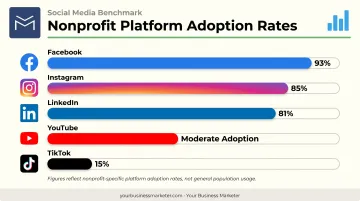
Facebook remains the platform nonprofits adopt most, with 93% maintaining a Page, per Nonprofit Tech for Good's 2026 data. Part of that dominance comes from built-in fundraising tools. Meta's nonprofit resources highlight options designed to keep giving on-platform:
- Page and post Donate buttons
- Nonprofit fundraisers
- Live fundraising
- Stories donation stickers
Instagram follows close behind at 85% nonprofit adoption, per the same benchmarking report. Its strength is visual storytelling. Reels and Stories let organizations show impact in motion rather than in a static post, a format that lands well with younger supporters who scroll fast and skip long captions.
LinkedIn shows 81% nonprofit adoption. Its real value lies in corporate partnerships, professional donor networks, and volunteer or employee recruitment. If your organization relies on corporate sponsorships or board connections, this is where those relationships get built and maintained.
Emerging Platforms: TikTok and YouTube
TikTok adoption among nonprofits is far lower, around 15%, reflecting the heavier lift short-form video requires. YouTube adoption runs higher than TikTok's, though still behind Facebook and Instagram.
Both can extend reach to niche or younger audiences, but they cost more production time than a lean team may have. Treat them as expansion channels once your core 2–3 platforms run smoothly—not as a starting point.
When you narrow the mix, weigh:
- Where your donors and volunteers already spend time
- Which formats your team can produce consistently
- Built-in fundraising or recruitment tools you will actually use
- Capacity to sustain 2–3 channels well before adding more
Content Frameworks That Build Trust: The 70/20/10 and 5-5-5 Rules
Knowing which platforms to use only solves half the problem. What you post, and how often you ask for money, matters just as much.
The 70/20/10 Rule for Nonprofit Social Media
This ratio, documented by Smart Insights as a flexible content-mix model, breaks down like this:
- 70% value content that builds community: stories, education, impact updates
- 20% curated or third-party content relevant to your cause
- 10% direct fundraising or promotional asks
This split matters. Supporters who see nothing but donation requests tune out fast—a pattern often called donation fatigue. Lead with stories and value so people stay engaged long after they've given once.
The 5-5-5 Rule for Social Media
This isn't a formally established industry standard, but it's a popular grassroots habit among nonprofit social media managers. The idea is to spend a few minutes each day on:
- 5 comments on posts from partners, donors, or local voices
- 5 likes on content tied to your cause
- 5 shares or reposts that amplify others’ work
Use that habit to strengthen ties with partner organizations, local journalists, and prospective donors—without spending a dollar on ads. It’s a low-lift way to stay visible in other people’s feeds, not just your own.
Common Mistakes Nonprofits Make on Social Media
Even well-intentioned teams fall into predictable traps:
- Spreading too thin: Posting inconsistently across five platforms instead of committing to a focused 2-3 channel approach
- Over-promoting: Leaning too heavily on donation asks without enough storytelling, breaking the 70/20/10 balance
- Skipping analytics: Failing to track performance or connect social activity back to broader organizational KPIs
Any one of these can stall growth for months before anyone notices the pattern.
When to Bring in Professional Help for Your Nonprofit's Social Media
Building a social strategy in-house works until capacity or expertise becomes the bottleneck. Bring in outside help when you see these signs:
- Staff bandwidth is stretched too thin to post consistently
- Growth has plateaued despite steady effort
- Nobody on the team has time to review analytics or adjust course
Agencies with nonprofit-specific programs can handle content creation, paid social, and reporting without stretching your team further. YBM's FIT program, built for mission-driven organizations, pairs programmatic advertising, paid social, SEO, geofencing, and conversion-focused reporting. Success is tied to donations and engaged supporters, not raw impressions.
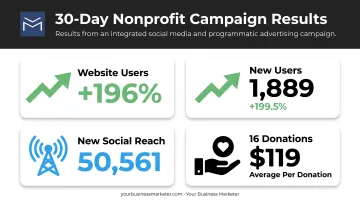
That approach has produced measurable results. In one 30-day case study for a family-run nonprofit, an integrated campaign that included social media and programmatic advertising drove:
- Website users up 196%
- 1,889 new users, a 199.5% increase
- 50,561 in new social reach
- 16 donations, averaging $119 each
When you evaluate partners, look past follower counts. Ask for nonprofit-specific experience and reporting tied to mission outcomes—donations and engaged supporters, not vanity metrics. Sector focus matters too: through YBM Gives Back, the agency awarded a $15,000 six-month marketing package to Coleman Health Services, a Kent, Ohio behavioral health nonprofit serving nine counties.
Frequently Asked Questions
How do you market your nonprofit on social media?
Start with clear goals, a defined audience, and 2-3 focused platforms. Pair consistent, story-driven content with regular engagement, like replying to comments and hosting Q&As, to build lasting community.
What is the best social media platform for nonprofit organizations?
Facebook and Instagram remain the most widely used among nonprofits, with LinkedIn strong for corporate partnerships and recruitment. The right choice ultimately depends on where your specific audience is already active.
What is the 70/20/10 rule for social media?
It's a content ratio: 70% value and storytelling, 20% curated third-party content, and 10% direct promotional or fundraising asks. That mix keeps supporters engaged without constant donation asks.
What is the 5-5-5 rule for social media?
It's a daily habit of commenting on 5 posts, liking 5 posts, and sharing or reposting 5 posts. Use it to build organic visibility and relationships without an ad budget.
How often should a nonprofit post on social media?
Two to three times per week per platform is a common benchmark. Consistency matters more than sheer volume, so a sustainable cadence beats an ambitious one you can't maintain.
Can small nonprofits with no budget succeed on social media?
Yes. Time and consistency matter more than budget. A focused strategy and free tools can drive real engagement and donations when paired with genuine storytelling.