
This scenario plays out constantly. The ad platform doesn't stop charging just because performance drops. PPC management is what determines whether that spend turns into profit or disappears into wasted clicks.
This guide covers what PPC management actually means, the tasks involved, typical costs, whether paid search still delivers results, and how to tell if your business needs expert help.
Key Takeaways
- PPC management is ongoing work: research, launch, monitoring, and optimization—not a one-time setup.
- Active management directly affects cost-per-click, quality score, and return on ad spend.
- Without dedicated oversight, businesses typically waste budget and miss qualified leads.
- In-house teams, freelancers, or agencies can run PPC—choose based on your bandwidth and expertise.
What Is Pay-Per-Click (PPC) Management?
PPC advertising is the billing model: you pay a platform like Google Ads or Microsoft Advertising each time someone clicks your ad.
PPC management is the ongoing service of running those campaigns effectively: strategy, daily decisions, and ongoing tuning that determine whether your ad spend actually converts.
These are two different things. PPC describes how you're charged. Management describes the work applied to make that charge worthwhile.
The Full Scope of Management
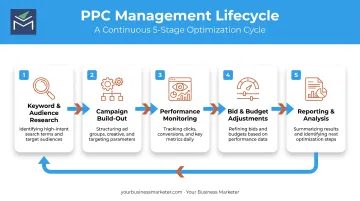
PPC management spans the entire campaign lifecycle, including:
- Keyword and audience research before launch
- Campaign build-out and structure
- Daily or weekly performance monitoring
- Bid and budget adjustments
- Ongoing reporting and analysis
Some businesses handle this in-house. Others hire a freelance specialist. Many turn to a full-service digital marketing agency, especially once campaigns span multiple platforms or ad types.
Why Unmanaged Campaigns Bleed Money
WordStream's 2025 Google Ads performance study of over 15,000 accounts found a median of $1,127.54 in monthly spend going toward clicks that never converted. The same analysis found 29% of accounts recorded zero conversions over a 90-day stretch. That's real money leaving the account with nothing to show for it.
Management principles apply across search, display, shopping, and remarketing campaigns — not just Google Search ads. A poorly monitored shopping campaign wastes budget the same way a neglected search campaign does.
What Does PPC Management Actually Involve? Key Tasks and Components
Here's where the "ongoing" part becomes concrete. Management is a weekly cycle of related activities running in parallel, not one isolated task.
Keyword Strategy and Negative Keywords
Keyword research doesn't end at launch. Managers continuously refine match types and add negative keywords to block irrelevant searches from draining budget.
WordStream found accounts using at least one negative keyword averaged a 13% monthly conversion rate, compared to just 4.6% for accounts with none, nearly three times the performance, per the same WordStream account study.
Ad Copy and Bid Management
Several related tasks run side by side:
- Write and A/B test headlines, descriptions, and extensions to lift click-through rate
- Fine-tune bids by keyword, device, location, and time of day
- Shift budget toward the keywords and ads that actually convert
Landing Pages, Tracking, and Reporting
Ad messaging has to match the landing page a click lands on, or the visitor bounces. Conversion tracking (calls, form fills, purchases) needs to fire correctly, or every decision downstream rests on bad data.
Reporting ties it together. Managers track CTR, CPC, quality score, conversion rate, and cost per conversion, then translate those numbers into real changes.
Staying Competitive Over Time
New competitors show up. Seasonal demand shifts. A campaign that performed well in March might underperform by August. Management means adjusting continuously, not reacting once a quarter.
Why Do Businesses Need Professional PPC Management?
Most business owners are running the business, not staring at bid adjustments and quality scores. That gap between available hours and required attention is where campaigns lose money unnoticed.
The Time and Data Problem
Weekly monitoring, ad testing, and data analysis take real hours. Skip a week, and underperforming keywords keep spending. Skip a month, and the account drifts far from where it needs to be.
Professional management also brings access to tools most owners don't have on hand:
- Bid automation platforms
- Competitor analysis tools
- Advanced conversion tracking and analytics
A Real Example of Coordinated Management
Your Business Marketer (YBM), a full-service digital marketing agency based in Hudson, Ohio, manages PPC as part of a coordinated multi-channel strategy paired with SEO, paid social, and reputation management—not as a standalone service.
One documented example: a Northeast Ohio HVAC contractor saw revenue grow 85% over two years after YBM implemented a combined digital strategy that included Google Ads alongside SEO, email marketing, and reputation management.
Over that same period, the client recorded $850,000 in overall revenue growth and a 12x return on investment. Those figures reflect the full coordinated strategy, not PPC alone, and show how sustained management across channels compounds results.

How Much Does PPC Management Cost?
There's no single number here, and anyone who quotes one flat price without context is oversimplifying. Total investment breaks into two separate pieces: ad spend (paid to the platform) and a management fee (paid to whoever runs the campaign, if you're not doing it yourself).
Common Fee Structures
According to Search Engine Journal's PPC pricing breakdown, agencies typically charge one of a few ways:
| Fee Model | Typical Range | Notes |
|---|---|---|
| Percentage plus base fee | $500–$2,500/month plus 5%–15% of ad spend | Most common structure |
| Flat-rate retainer | $2,500–$10,000/month | May or may not include media spend |
| Performance-based | Charged per lead or conversion | Often leaves account ownership with the agency |
What Drives the Price Up or Down
- Industry competitiveness: Some keyword categories cost far more per click than others
- Campaign and platform count: More campaigns and channels mean higher management effort
- Optimization depth: Creative testing, tracking setup, and ongoing tuning raise the fee
Search Engine Journal also notes that advertisers spending under $2,500 a month may find management fees eat up too much of the budget. In that range, internal management or automation is often worth considering first.
Does PPC Still Work?
Yes, and the data backs it up. According to WordStream's 2025 Google Ads benchmark report, covering over 16,000 US search campaigns:
- Click-through rate: 6.66% (up 3.74% year-over-year)
- Cost per click: $5.26 (up 12.88%)
- Conversion rate: 7.52% (up 6.84%)
- Cost per lead: $70.11 (up 5.13%)
Costs are rising, but so is performance. Paid search still delivers high-intent traffic when it's run well.
Automation Still Needs a Strategist
Most advertisers now lean on automated smart bidding, and broad match is the default for new search campaigns. Google's own guidance pairs broad match with smart bidding so algorithms get more data to optimize against.
Automation still needs human oversight. Left unchecked, broad match can pull in irrelevant searches fast, and smart bidding can chase the wrong goals if conversion tracking isn't set up correctly. The tools got smarter. The need for a strategist watching the account didn't go away. If anything, it got more important.
Signs You Need a PPC Management Partner
Several warning signs usually appear before a business owner brings in outside help:
- Ad costs keep climbing while leads stay flat or drop
- Nobody has reviewed the account in weeks
- Spend is steady, but results stopped improving months ago
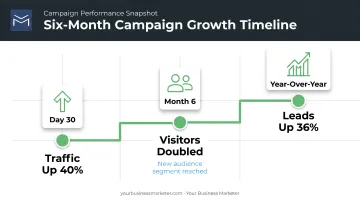
A group of five Buy Here Pay Here dealerships in Wisconsin hit that wall. Their PPC campaigns weren't driving enough traffic to meet sales goals. After a full rebuild, site traffic rose 40% within 30 days, visitors doubled within six months, and leads grew 36% year-over-year.
What to Look for in a Partner
When you evaluate a PPC management partner, prioritize:
- Transparent reporting that shows exactly where money goes and why
- Month-to-month flexibility instead of long-term lock-in contracts
- Proven experience in your industry, including home services, dealerships, medical practices, and nonprofits
Frequently Asked Questions
What is pay-per-click management?
PPC management is the ongoing process of researching, launching, and optimizing paid ad campaigns to improve performance. It includes everything from keyword research to daily bid adjustments and reporting.
How much does pay-per-click cost?
Cost depends on two separate factors: ad spend (which varies widely by industry) and management fees if you hire an agency or specialist. There's no fixed universal price.
Does pay-per-click still work?
Yes — when campaigns are actively managed. Left on autopilot, performance usually slips; with ongoing bid, creative, and landing-page work, PPC still drives strong leads and sales.
Can I manage my own PPC campaigns, or do I need an agency?
DIY management is possible, but it requires significant weekly time and specialized knowledge of bidding, testing, and tracking. Many busy owners find an agency more practical.
How long does it take to see results from PPC management?
Initial visibility can happen almost immediately after launch. Meaningful optimization and ROI improvements typically take a few weeks of data-driven adjustments to show up.
What's the difference between PPC advertising and PPC management?
PPC advertising is the pay-per-click billing model itself — you pay when someone clicks. PPC management is the ongoing strategic service of running and optimizing those campaigns over time.