
Outsourcing SEO looks simple on paper — hire someone, hand off the keywords, watch rankings climb. In practice, results vary wildly depending on who you hire, what you delegate, and how you manage the relationship afterward.
This guide breaks down what SEO outsourcing actually means, the signs it's time to consider it, the exact steps to do it well, realistic cost ranges, and the mistakes that sink most outsourcing relationships before they get started.
Key Takeaways
- Outsource SEO when you need specialist skills without the cost of building an in-house team
- Freelancers, agencies, and in-house hires each carry different price points and trade-offs
- Clear goals, a defined scope of work, and regular performance tracking matter more than the lowest bid
- Hand off on-page optimization, technical audits, content, link building, and local SEO to specialists
What Is SEO Outsourcing (and When Should You Consider It)?
SEO outsourcing means delegating some or all of your search optimization work to an external agency, freelancer, or consultant rather than managing it with internal staff. That can mean handing off the entire strategy or just specific pieces, like technical audits or content production.
Signs It's Time to Outsource
The most common trigger is simple: your team doesn't have the bandwidth or expertise, and SEO tasks keep piling up unaddressed. Search Engine Journal's practitioner survey found that 14.9% of SEO professionals cite lack of resources as their single biggest challenge. Scaling processes ranked close behind at 11.9%.
Watch for these signals:
- Organic growth has plateaued despite consistent effort (an outside audit often finds quick wins internal teams miss)
- You're expanding into new markets or facing bigger competitors with more marketing muscle
- SEO tasks sit untouched for weeks because nobody owns them
- You lack tools for technical audits, rank tracking, or competitor analysis
That last gap shows up often in YBM client work. One Northeast Ohio HVAC contractor had a strong local reputation but almost no online visibility because nobody owned its search presence.
What SEO Services Can You Delegate?
Almost any piece of SEO can be outsourced solo or as a full package:
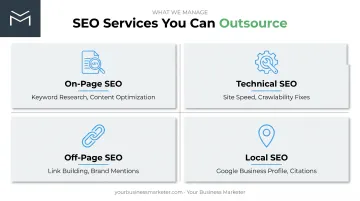
- On-page SEO: keyword research, content optimization, internal linking, site structure
- Technical SEO: site audits, page speed fixes, crawl error resolution, schema markup for traditional and AI-driven search
- Off-page SEO: backlink acquisition, digital PR, directory citations
- Local SEO: Google Business Profile optimization and local keyword targeting (high value for contractors, dealerships, and medical practices)
How to Outsource SEO Services: A Step-by-Step Guide
Outsourcing SEO well takes a real process, not a one-and-done vendor handoff. Skip steps and most relationships go sideways.
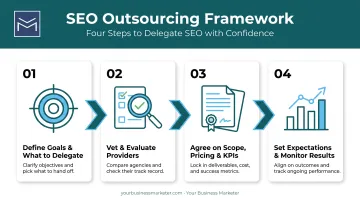
Step 1: Define Your Goals and What to Delegate
Vague goals like "get more visibility" produce vague results. Instead, set concrete targets:
- More local leads (a specific number, not "more")
- National scaling into new service areas
- Revenue growth tied to organic traffic
- Ranking for a defined set of priority keywords
Once goals are set, decide what stays in-house. If your team can handle content but lacks technical SEO skills, delegate the technical work and keep content internal. Match the split to your actual skill gaps, not assumptions about what "SEO" requires.
Step 2: Vet and Evaluate Potential Providers
Before signing anything, check:
- Industry-relevant case studies: has this provider worked with businesses like yours?
- Third-party reviews on Clutch, G2, or Google
- Communication style during the sales process (if they're vague now, they'll be vague later)
Red flag: any provider guaranteeing specific rankings or overnight results. Google states plainly that "no one can guarantee a #1 ranking on Google," and warns businesses to be wary of anyone claiming a special relationship with Google or promising priority placement, per Google's guidance on hiring an SEO.
Step 3: Agree on Scope of Work, Pricing Model, and KPIs
Get deliverables, timelines, and milestones in writing before work begins. Verbal agreements lead to scope creep and finger-pointing later.
Decide on a pricing structure:
- One-time project fee: best for narrow, defined tasks like a single technical audit
- Monthly retainer: better for ongoing strategy, since algorithms and competitor behavior keep shifting
Align on KPIs that actually matter: organic traffic, keyword rankings, and conversions. Skip vanity metrics like impressions or social shares that don't tie to revenue.
Step 4: Set Expectations, Establish Collaboration Rules, and Monitor Results
SEO isn't instant. Ahrefs polled thousands of practitioners and found that most SEO work takes 3-6 months to show measurable results, though the exact timeline depends heavily on competition and site authority, per Ahrefs' research on SEO timelines.
To keep the relationship accountable:
- Set a reporting cadence (weekly or monthly) that matches how involved you want to stay
- Assign a single point of contact on both sides so nothing falls through the cracks
- Treat the first 60-90 days as a validation period and compare early results against your agreed KPIs before committing long-term
Choosing the Right Outsourcing Model and Understanding Costs
The right model depends on your budget, project complexity, and how much day-to-day control you want to keep.
SEO Agencies
Agencies bring a full team of specialists (strategists, content writers, and technical SEOs) plus access to tools most businesses can't justify buying on their own.
- Pros: Comprehensive, multi-channel support and specialist depth
- Cons: Highest cost option, with less granular control over individual tasks
According to Ahrefs' 2024 SEO pricing survey of 439 SEO service providers, the average agency retainer runs $3,209 per month. Among providers across the U.S. and Canada, nearly 79% charged at least $1,001 monthly, though pricing varies widely by scope.
Full-service agencies that bundle SEO with PPC, paid social, and reputation management, such as Your Business Marketer, can reduce the vendor-juggling headache for business owners who'd rather have one accountable partner than five separate invoices.
Freelancers
Freelancers are the most budget-friendly option for narrow, well-defined tasks like keyword research or on-page fixes.
- Pros: Lower cost, flexible for small-scope work
- Cons: Limited capacity for large projects, inconsistent availability since freelancers juggle multiple clients
Ahrefs reported a global freelancer average of $71.59 per hour, while Upwork lists a lower median range of roughly $15-$35 per hour for its broader marketplace of SEO professionals.
In-House Hiring
Bringing SEO in-house gives you full control over strategy and tighter coordination across departments.
- Pros: Complete strategic control, easier cross-team alignment
- Cons: High upfront investment in recruiting and tools, slower to scale when demand spikes
Salary.com pegs the average annual salary for a U.S. SEO Specialist at $96,156 as of 2025, before benefits, software licenses, or training costs.
| Model | Typical Cost | Best For |
|---|---|---|
| Agency | ~$3,209/month average | Full-service, multi-channel needs |
| Freelancer | $15-$75+/hour | Narrow, defined tasks |
| In-House | ~$96,156/year salary | Businesses needing full strategic control |
Common Mistakes to Avoid When Outsourcing SEO
Most failed outsourcing relationships come from a handful of predictable errors:
- Chasing the lowest price: Cheap SEO often means outdated or risky tactics that hurt rankings long-term.
- Skipping goal-setting: Handing off work without clear objectives leads to misaligned strategy and wasted budget.
- Trusting guaranteed-ranking promises: No legitimate provider can guarantee a #1 spot. Providers who claim otherwise are a red flag.
- Ignoring KPI tracking: If you're not checking agreed metrics regularly, you can't tell whether the investment is working.
Conclusion
Outsourcing SEO works when you set clear goals, choose the right partner deliberately, and track performance consistently — not leave it on autopilot. Most failed outsourcing relationships trace back to poor upfront planning, not a flaw in the concept itself.
For business owners who want measurable growth without managing every technical detail themselves, a full-service partner like Your Business Marketer offers SEO alongside PPC, reputation management, and paid social. That means one accountable relationship instead of several vendors to coordinate.
Frequently Asked Questions
What is SEO outsourcing?
SEO outsourcing means hiring an external agency, freelancer, or consultant to manage some or all of your search optimization work instead of handling it with internal staff.
How much does it cost to hire someone to do SEO?
Costs range from roughly $15–$75+ per hour for freelancers, to an average of about $3,209 per month for agencies, to about $96,000 annually for an in-house specialist. Pricing depends on scope and complexity.
Is outsourcing illegal in the US?
No. Outsourcing business functions like SEO is fully legal in the U.S. Businesses should still ensure contracts clearly address data ownership, confidentiality, and worker classification.
How long does it take to see results from outsourced SEO?
Most strategies show measurable movement within 3-6 months, depending on competition and existing site authority. Faster onboarding and clear goal-setting can help shorten that timeline.
Should I choose an agency, freelancer, or in-house team?
It depends on your budget, project complexity, and how much control you want to retain. Agencies suit full-service needs, freelancers suit narrow tasks, and in-house hires suit businesses wanting complete strategic control.
What SEO tasks are most commonly outsourced?
On-page optimization, technical audits, content creation, link building, and local SEO are frequently delegated tasks, since they demand specialized skills many businesses lack internally.